 Chocolatey
Releases85
Frequency1 week 16 hours
Last Release
**Background**
pnpm uses a content-addressable filesystem to store all files from all module directories on a disk.
When using npm, if you have 100 projects using lodash, you will have 100 copies of lodash on disk.
With pnpm, lodash will be stored in a content-addressable storage, so:
1. If you depend on different versions of lodash, only the files that differ are added to the store.
If lodash has 100 files, and a new version has a change only in one of those files,
`pnpm update` will only add 1 new file to the storage.
1. All the files are saved in a single place on the disk. When packages are installed, their files are linked
from that single place consuming no additional disk space. Linking is performed using either hard-links or reflinks (copy-on-write).
As a result, you save gigabytes of space on your disk and you have a lot faster installations!
If you'd like more details about the unique `node_modules` structure that pnpm creates and
why it works fine with the Node.js ecosystem, read this small article: [Flat node_modules is not the only way](https://pnpm.io/blog/2020/05/27/flat-node-modules-is-not-the-only-way).
**Getting Started**
- [Installation](https://pnpm.io/installation)
- [Usage](https://pnpm.io/pnpm-cli)
- [Frequently Asked Questions](https://pnpm.io/faq)
- [Chat](https://r.pnpm.io/chat)
- [X](https://x.com/pnpmjs)
- [Bluesky](https://bsky.app/profile/pnpm.io)
**Benchmark**
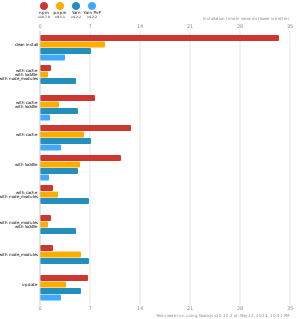
pnpm is up to 2x faster than npm and Yarn classic. See all benchmarks [here](https://r.pnpm.io/benchmarks).
Benchmarks on an app with lots of dependencies:
Collections containing this project
Showing collections based on your access.
This project is not in any collections you can view.